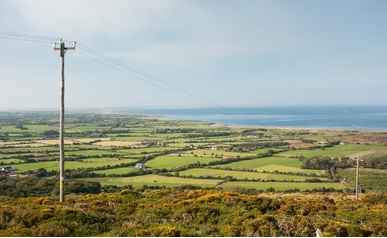
This was a short story I had to write for my bachelor’s back in Limerick years ago. While primitive, it was one of the first times I had actually produced a written creative work in full, and was honestly very proud of it at the time. There is plenty I would change now, but working on this assignment taught me some valuable writing lessons that have stuck with me since. This powerless, Irish dystopia is one that I will return to again in a future project I reckon, but for now it lives on in this little cosm of mine from years passed. Hope you enjoy it!
Since the Power Went Out
By Aaron Lowry
Horse hooves clacketed down Main Street, kicking up mud and rubble as I watched on from an adjacent alley. Hauling my sack of steel close to me, I hugged the wall and carefully raised my camcorder. The iridescent shine of blue light reflected off my face as I traced it along the rustic street, focusing on the riding militia men. It’d make for some good B-Roll. I clamped the screen neatly shut and tucked it away before continuing on. I knew to be mindful of the militia this side of town, they weren’t likely to let me pass without shaking me down first. I maneuvered along Main Street and passed through alleys to avoid the eerily quiet square. High in the windows of the old town apartments and council houses were sentries, their eyes like cameras watching the streets leading to the square, rifles steadily at the ready. Sticking to the path I knew well, I crossed to the other side of the Whitehorse River where I knew it was safer, where I could take the camcorder out again.
I dragged the camera along the derelict buildings of Mountrath town, the boarded up fronts reinforcing their lifelessness. I figured I should provide some commentary, to fill the silence which loomed still across the town. It’s been a year and twenty seven days since the power went out, though admittedly it’s been harder to keep track the further we get from outage day. Dad likes to keep count, says it reminds him that time is, in fact, still moving despite all the clocks hanging still. Time stood paused, cars were left still in drives and light became a finite resource. All electronic devices ceased to function. I allowed the camera lens to hang uneasily on a shot of a cracked street light, which had lost its purpose long ago now. Dad had sent me in to get candles and turf off the Moores. The last time I came to the church trading they wouldn’t part with their turf, Mary at the gate was insistent that they needed all they had for winter. I told Dad that too, to which he responded,
“She’ll have candles,” and left it at that.
The Moores chose a right spot when they set up in the church. When the raidings got worse, they took in a load of families and fortified the place up. Now they’re one of the three families running Mountrath, and the church is their stronghold and trade centre. They were also the only family we were on decent terms with, decent enough to trade, not quite enough to be let in though. As I reached the church, I carefully laid the camera down in an opposite alley, and left it running as I tipped over to the main gate. The wooden wall perimeter stretched from the gate and wrapped around the church yard, leading to an even more fortified entrance to the church itself, though it’d been ages since I had been past the main gate. The camera sat still and watched as I wrapped the gate, giving a sequential knock, a code, which let them know I was here to trade. A few words, latch opens and bag exchanges later and I was up fifty candles.
The walk home was always arduous. Raiders swept the roads in hopes of clashing with traders vans or moving settlements, or in this case a kid with fifty candles. So I avoided the roads, walked the fields and kept the camera running. Crows stirred from haunting branches above, their caws resonating into the emptiness of once cow ridden fields. The power lines hung in suspended mockery. Since the power went out, cities have been cesspools for looters. Not that they have much of importance going on now anyways, rural towns became man’s bastion of survival with farmers and laborers winning the career lottery in this new, powerless dystopia. Dad had gone through phases of carpentry and engineering work, but now he was a full time metal smith. Up in the Slieve Blooms, our once humble two story was now an iron fortress of spiked bars and metal perimeters. A bit overkill for it being just the two of us I’ve always reckoned, but he’s just been that way since Mam died. I kept the camera raised high as I pushed through dense hedges and ditches. Some of them still had barbed wire from when the Fitz’ set up here in the Spring. Rust, blood and muck were each embedded into the barbs. The smell was dire, not that the camera could capture that. I got thinking of Mam again as I startled more crows. We spent the first few months after outage day trying desperately to get her prescription medication, but it was no use. We lost my sister Elle then when winter came, the coldest one in years it felt. That’s what had everyone on edge now, summer had come to a close and hopes were running out. Still no contact from outside of Ireland, still no power. Now we had another winter to face. I approached another barbed ditch, this one had an old wooden plank strung across it. We left some of these about to make traversal easier, despite Dads reservations. My boots, welded with hardened mud, slapped off the wood as I paced over the gaps. More crows took off then, bar one which sat on a close branch staring at me. I let the camera linger on it for a moment. Mam used to always say I was for the birds, not in the sense that I was mad, but just how things didn’t phase me. I held the camera steady at the carrion crow who stared back, its eye meeting the lens. Did they even know the power was gone? With that thought, the crow took off and joined his murder in the sky. Maybe they have no idea.
Our home stood atop a hill amidst a trail of trees which helped obscure it from the outside world. Not too lost in the mountains, not too submerged in town, it checked the boxes for our little survival shelter. Dad had spent the better part of the year reinforcing it with any metals he could melt, leading to the ugly amalgamation of spiked steel which surrounded the house like a moat. I steadied to a comfortable saunter as I approached the house, zooming carefully, showing off the house’s widowed features. The walls were violently jagged, an indication for any visitors to stay away. That’s when I saw it, and my heart began to race. One of the doors, typically bolted shut with a plethora of locks and latches, was dented and hanging ajar. I froze still, watching through the camera, in slight disbelief that anyone had attempted and succeeded to breach our needlessly fortified shelter. Yet the door was there, ajar and creaking open with the ambient mountain breeze. I kicked off towards it then, trudging through the mudded fields and onto the rough dirt path that carved the way towards our house. I steadied at the door, and slinked in, camera first. I could hear shuffling and incoherent murmurs echoing through the walls. It was strange hearing another voice that wasn’t Dad’s in the house. I continued forward, the camera capturing our hollow hallway, lined with melted candles, improvised tools, and remnants of the home this once was. I reached the kitchen then and carefully peered inside. Two men came into view, rummaging through our dusty barren kitchen shelves. They were lightly armoured, their clothes tattered and torn. They weren’t from town, they’d been on the road a while. They were desperate. Hugged tightly behind one of the kitchen doors was Dad, his narrow, violent eyes darting between me and the men. His thick fingers gripped a metal pipe, which had been altered with clumps of spiked metal. He gave me a quiet nod and turned to the unknowing men. Then it all happened so fast. Dad blurred as he swung wide from behind the door, crashing the pipe against the first man’s cranium with lethal force. Crimson slicked the kitchen, as the monstrous pipe bludgeoned through the stranger. His body limped to the floor, knocking our chairs as the kitchen erupted in a cacophony of wood screeching off tiles. Dad lunged forward, getting the pipe beneath the chin of the next man and gripping it tightly, letting the lead bar strangle and crush the invader’s throat. The man’s feet kicked violently, sloshing in the deep pooling blood. The kitchen grew quiet then and we looked at each other, I was pale as milk, Dad was flushed red like a bloated plum.
“You get the candles?” He asked, tossing the pipe down and moving towards me. I nodded timidly. Then his face scrunched up, scowling in confusion. “What’s in your hand?” I tried to pull it away, but his bloodied paw snatched the camcorder from me. He eyed it puzzled, turning it around and staring at its blank, cracked, broken screen. Lifeless. He glanced back at me then, “you’re for the birds,” he said begrudgingly, tossing the camera aside into the bloodied pool which was coalescing on the kitchen floor.